



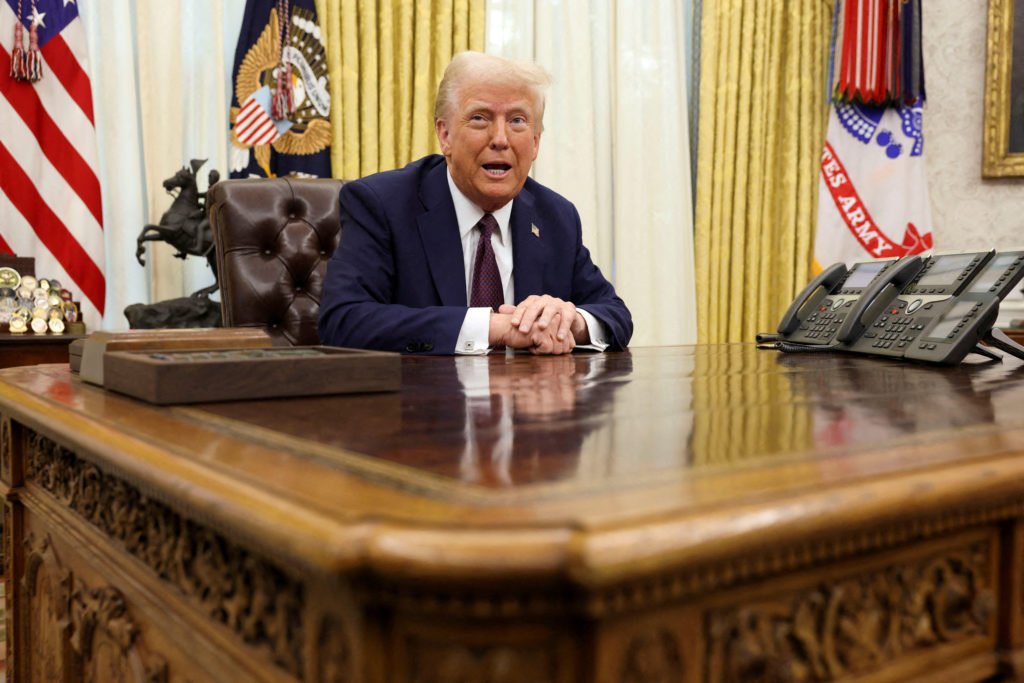
President Donald Trump’s push to assert greater control over independent federal agencies will go before the Supreme Court on Dec. 8. It is the second of at least four major cases this term involving Trump’s broad interpretation of presidential authority.
Trump is asking the justices to overturn a 1935 precedent that restricts presidents from removing leaders of multi-member independent agencies — a limitation that affects bodies such as the Federal Reserve and the Federal Trade Commission (FTC).
The court has gradually weakened this precedent since 2010, and with its current conservative supermajority, it may now go further. Even if the justices stop short of fully eliminating the ruling, they are expected to narrow it in ways that could significantly shift the balance of power among the president, Congress, and the country’s independent agencies.
A ruling in Trump’s favor could immediately give him authority over the FTC, which enforces antitrust and consumer protection laws across nearly every sector of the economy. Many other agencies could also be affected — including those regulating campaign finance, worker protections, business fraud, media and broadband, and transportation safety.
“This case marks a pivotal moment for the separation of powers, with the potential to redefine how dozens of government agencies operate,” said Varu Chilakamarri, a former Justice Department attorney now with K&L Gates.
Conservatives Advance the ‘Unitary Executive Theory’
Congress designed these agencies to be run by bipartisan boards of experts with fixed terms. But conservatives argue that the Constitution gives presidents full authority over all executive functions — including the power to remove agency officials at will. Without that authority, they say, agencies become insufficiently accountable and contribute to what critics describe as the “administrative state.”
“Congress can create a wide-ranging executive bureaucracy, but it cannot put that bureaucracy beyond the president’s responsibility,” said Oliver Dunford of the Pacific Legal Foundation.
Trump’s Attempted Firings Spark Court Battles
After taking office, Trump asserted that all federal agencies ultimately fall under his control. In March, he fired two Democratic commissioners on the FTC, Rebecca Kelly Slaughter and Alvaro Bedoya.
Lower courts ruled that, under the 1935 decision Humphrey’s Executor v. United States, Trump could remove FTC commissioners only for cause — something he did not claim. Courts issued similar rulings after Trump dismissed Democratic members of the Consumer Product Safety Commission and two federal labor boards.
However, the Supreme Court stepped in and allowed those firings to proceed while legal challenges continue. It also fast-tracked review of whether Congress’s removal protections for FTC commissioners violate constitutional separation of powers.
Separately, the Court will hear a January case on whether Trump can dismiss a Federal Reserve board member for alleged misconduct. Other cases this term address Trump’s authority to impose sweeping import tariffs and whether his constitutional interpretation would permit the denial of U.S. citizenship to some babies born on American soil.
Trump Calls Removal Power ‘Indispensable’
In the Dec. 8 case, Trump v. Slaughter, the administration argues that the ability to remove agency leaders is essential for the president to fulfill his duty to ensure that laws are faithfully executed.
The Supreme Court in 1935 ruled that the FTC’s responsibilities were “neither political nor executive,” but “quasi-judicial and quasi-legislative,” and therefore its commissioners should be insulated from political pressure. The Justice Department now argues that such reasoning no longer applies.
“The modern FTC … exercises executive power — indeed, quite a bit of it,” Solicitor General John Sauer wrote, claiming the agency can impose penalties, write binding rules, and investigate legal violations. He urged the Court to overrule what remains of Humphrey’s Executor.
Concerns About Turning Agencies Into ‘Lapdogs’
Alvaro Bedoya, one of the commissioners Trump fired, warned that a ruling for the president would allow him to treat independent agencies “like his little lapdog.”
He pointed to the FTC’s recent $2.5 billion settlement with Amazon over alleged deceptive Prime enrollment practices. Bedoya argued the settlement was too lenient and said the public may doubt the agency’s independence, especially when major companies contribute to presidential inauguration funds.
“It calls into question the ability to police industries that are essential to our lives,” he said.
But the Court may not be sympathetic. When the justices allowed Trump to fire three Democratic members of the Consumer Product Safety Commission in July, Justice Elena Kagan observed that her conservative colleagues had “all but overturned Humphrey’s Executor.” Justice Brett Kavanaugh said there is “at least a fair prospect” the Court will overturn it entirely.